Disclosure: This post contains affiliate links at no extra cost to you.
In an era where technology often feels like a gated community for those who speak the language of code, a beautiful shift is taking place. The barriers to entry are dissolving, replaced by intuitive, elegant platforms that turn the act of creation into a seamless, visual experience.
You no longer need to be a programmer to build a digital sanctuary for your thoughts, your art, or your business.
Today, the tools available to us allow anyone—from the curious hobbyist to the ambitious entrepreneur—to host, design, and share content with the world effortlessly.
By stripping away the complexity of backend management, these platforms invite you to reclaim your focus, channeling your energy entirely into your unique message and the stories you have yet to tell.
This guide serves as your compass, illuminating the path toward a digital presence that is as vibrant and authentic as you are.
1. WordPress
WordPress.com is a top choice for publishing because it provides a reliable, all-in-one environment. You can start for free, choose from thousands of design templates, and begin writing your posts immediately. Its block-based editor allows you to arrange text and images exactly how you want without writing a single line of code.
• Ease of use: Very beginner-friendly with a drag-and-drop interface.
• Built-in hosting: You don’t need to find a separate server; they manage it for you.
• Customization: Access a huge library of themes to change your site’s look.
• Mobile-ready: Your site automatically looks great on phones and tablets.
• Growth: You can easily add more features as your audience grows.
2. Wix
Wix is widely known for its extremely visual, intuitive editor that gives you total design freedom. It is perfect for those who want a polished, professional look without technical headaches.
The platform includes a powerful AI tool that can build your site structure for you, making the start-up process nearly instant.
• Visual Editor: Click and move any element on your page freely.
• All-in-one: Hosting, domain, and security are all managed in one place.
• App Market: Easily add features like contact forms or galleries.
• Templates: Hundreds of designer-made layouts for every industry.
3. Squarespace
Squarespace is famous for its beautiful, high-quality templates that make any content look like it was designed by a professional. It is an excellent alternative to WordPress if you prioritize visual impact and a clean, minimalist style.
The setup process is very fast, and it is designed to be stress-free for non-technical users.
• Award-winning designs: Templates that prioritize photography and style.
• Integrated tools: Built-in features for blogging, email, and analytics.
• Responsive: All designs are mobile-friendly by default.
• Support: Helpful guides and tutorials for every step of your journey.
4. Ghost
Ghost is a focused platform built specifically for writers, bloggers, and creators who want to build an audience. It removes the extra clutter found in larger platforms, providing a clean, distraction-free environment for writing.
It is particularly great if you are interested in newsletters or building a community around your content.
• Focus on content: A clean editor that helps you get words on the page.
• Membership features: Built-in tools to manage subscribers and paid content.
• Simplicity: Minimal setup needed to get your blog live.
• Speed: It is highly optimized for fast loading and reading.
5. Canva
Canva has evolved into a fantastic tool for creating and publishing simple websites or landing pages directly from their platform. If you already use it for design, you will find their website builder just as easy to navigate.
It is a great option for creating quick, visually striking pages that highlight your projects or personal brand.
• Drag-and-drop: Familiar interface for anyone who has used Canva before.
• Design elements: Easy access to millions of icons, photos, and fonts.
• Quick publish: Launch a simple, one-page site in minutes.
• Free assets: Access to a vast library of graphics to make your content pop.
6. Substack
Substack is a unique platform that simplifies publishing by focusing on newsletters. You can create content that is sent directly to your readers’ email inboxes while also hosting it as a blog on their site.
It is arguably the simplest way to start publishing if your primary goal is to share writing and reach people directly.
• Built-in audience: A simple way to grow your email subscriber list.
• No technical hurdles: You just focus on writing; the platform does the rest.
• Monetization: Easy tools to set up paid subscriptions for your readers.
• Simplicity: No need to manage a complex website layout or design.
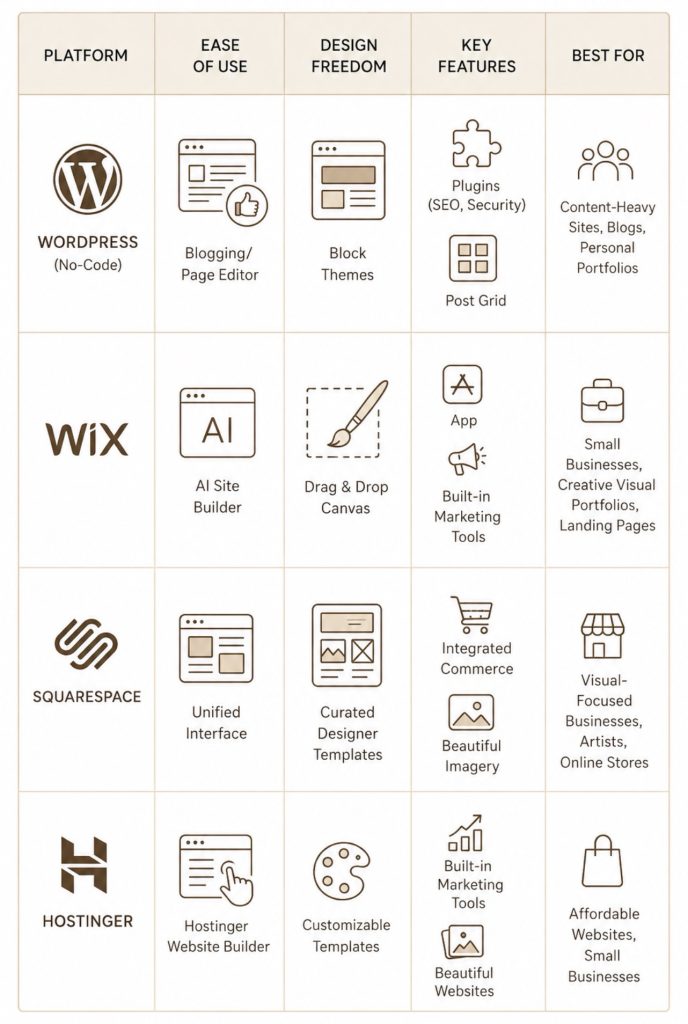
A Comparative Overview of Popular Website Building Platforms
Stay connected for more digital lifestyle tools, apps, and website guides.
— Happy Reading from Tia —
Leave a Reply